

Loading...

Today, in this solution, we will tell you how you can enable Salesforce Sites and create public websites and applications integrated into your Salesforce organization directly and without even having your users log in with a username and password. So, if this is something that intrigues you, then keep on reading!

Learn how to set up Salesforce Sites with this ultimate step-by-step guide!

Steps

Figure 1: Go to Setup, enter Sites in the Quick Find box, then select Sites.

Figure 2: Register the Salesforce Sites domain based on your organization.
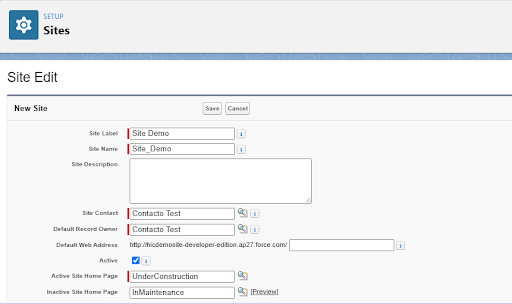
Figure 3: Now, create and configure your site. Develop Visualforce pages and use them for your site, you can also use or hide standard pages, and customize error pages. Associate the pages with your site.

Figure 3.1: Choose a site template using the lookup field to find a template you have developed. Enable a portal for login or self-registration, and then associate it with your site.

Figure 3.2: When you’re done, click Activate on the site details page. Alternatively, you can activate your site from the Site Edit and Sites pages.

Conclusion

There you have it! The simplest solution to setting up Salesforce sites. We hope that you liked this solution and it was helpful for you. If you try this out, then don’t forget to share your experiences with us. Also, if you need further help in putting this solution in place or any other, then Salesforce experts can help. Get in touch with us. We will be back with another Salesforce solution soon. Till then, happy learning! 🙂


Share This Blog
Table of contents
Related Articles

Sticky notes aren’t just for your desk anymore! In this tutorial, we’ll create a Lightning Web Component (LWC) in Salesforce that allows you to pin notes on your app page or record page. With a clean, interactive UI, these digital sticky notes ensure you never forget important tasks or details. What Will You Learn? By […]

Read More
How to Create Dynamic, Animated Charts in Salesforce LWC using Chart.js

Bring Salesforce data to life with dynamic charts inside Lightning pages! While Salesforce dashboards are powerful, sometimes business users want visual insights without leaving their current page. That’s where Chart.js with Lightning Web Components (LWC) becomes a game-changer. In this step-by-step guide, you’ll learn how to: Upload Chart.js as a static resource in Salesforce. Build […]

Read More
How to Encrypt and Decrypt Data in Salesforce Using Apex Crypto Class

Data security is more important than ever. Whether you’re storing customer information, sensitive business data, or private communication, ensuring that your data stays safe is critical. Salesforce provides built-in tools to help with this, and one of the most powerful yet easy-to-use approaches is encryption and decryption using the Apex Crypto class. In this blog, […]

Read More
Benefits & Step-by-Step Setup Guide for Salesforce Code Analyzer

When building on the Salesforce platform, code quality and security are non-negotiable, especially before submitting your app for a Salesforce Security Review. Catching bugs and vulnerabilities early not only saves time but also ensures compliance with Salesforce’s best practices. That’s where the Salesforce Code Analyzer comes in. This open-source tool scans your Apex classes, triggers, […]

Read More
A Step-by-Step Guide to Integrate Zoho CRM with Salesforce (Without Coding)

Managing data across multiple CRMs can be a real challenge for businesses that want a single source of truth. If your teams use Zoho CRM but want to move or sync all records seamlessly into Salesforce, you don’t need to write a single line of code. Thanks to MultiSync Made Easy, the integration process is […]

Read More
How to Integrate Salesforce with Copilot

Integrating Salesforce with Copilot is becoming an essential step for organizations aiming to streamline workflows, automate client data management, and unlock the power of AI-driven CRM. By connecting these two platforms, businesses can centralize customer information, reduce manual tasks, and accelerate growth. This guide walks you through the Salesforce–Copilot integration process with clear steps, Apex […]

Read More