The digital economy demands agility, personalization, and cloud-first solutions. As a result, Salesforce has become the world’s #1 CRM platform, powering major businesses across industries. But the true magic behind successful Salesforce projects isn’t just the technology; it’s the expertise and insight brought by a certified Salesforce Partner.
These specialized consultancies, integrators, and developers steer companies through transformation, maximizing value and accelerating innovation. Whether launching your first CRM or customizing an enterprise-grade solution, partnering with a proven Salesforce Partner can be the difference between ordinary and extraordinary results.
Who is a Salesforce Partner?
A Salesforce Partner is a trusted organization formally recognized by Salesforce to deliver consulting, implementation, integration, and software solutions on the Salesforce platform. These partners are carefully vetted, certified, and supported by Salesforce itself. Their goal: to ensure clients maximize ROI from Salesforce’s vast suite of cloud applications.
Salesforce Partners go beyond typical IT consultancies by maintaining deep product knowledge, industry specialization, and direct access to Salesforce resources. They’re mandated to deliver measurable results, maintain high standards of customer trust, and stay updated with Salesforce’s constant evolution.
Decoding the Salesforce Partner Universe: Types You Should Know
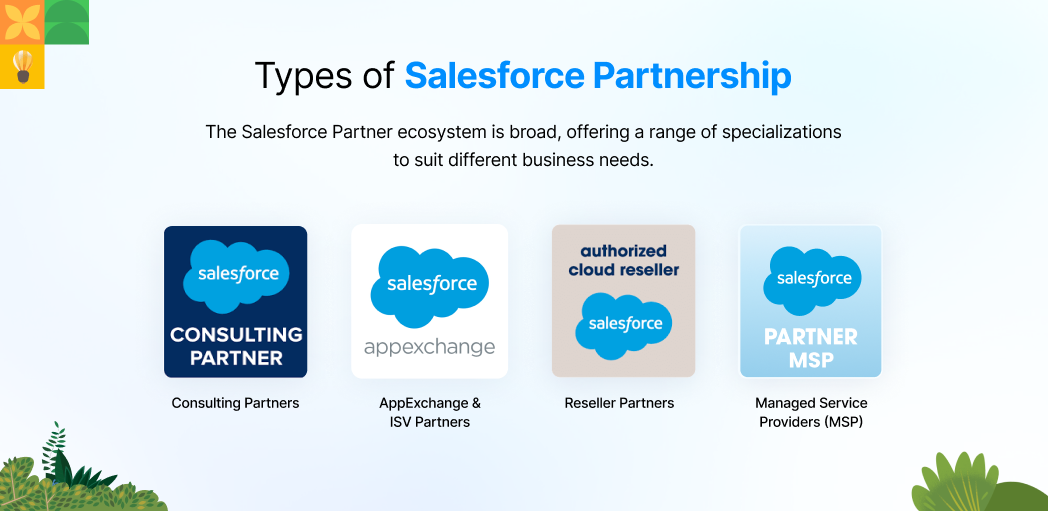
The Salesforce Partner ecosystem is broad, offering a range of specializations to suit different business needs.
Consulting Partners: Consulting partners are the strategic guides for businesses launching or expanding Salesforce. They provide business analysis, implementation expertise, training, integration, and ongoing support.
AppExchange & ISV Partners: Independent Software Vendors (ISVs) and AppExchange partners design, build, and market apps/extensions that plug into Salesforce, expanding its functionality with new features tailored for every imaginable use case.
Managed Service Providers (MSPs): MSPs focus on ongoing management after initial go-live. They handle administration, upgrades, troubleshooting, and continuous improvement, becoming an extension of your IT team.
Reseller Partners: These partners specialize in selling official Salesforce products, often suited for emerging markets or smaller businesses needing a streamlined procurement process.
System Integrators (SI): System Integrator partners specialize in integrating Salesforce with other critical platforms and automating cross-system workflows, enabling true digital transformation beyond CRM.
Salesforce Crest Partner: Salesforce Crest Partner is a prestigious tier within Salesforce’s partnership program, reflecting a high level of expertise and demonstrated customer success. Crest Partners has attained a significant number of partner points through certifications, successful implementations, and customer satisfaction scores.
Salesforce Partner Program Levels & Tiers
Salesforce classifies partners by expertise, experience, and business impact, helping clients discover the most capable organizations for their needs.
Traditional Tiers:
- Registered
- Silver
- Gold
- Platinum/Global Strategic
Modern Tiering System (2025 and Beyond):
- Base
- Ridge
- Crest
- Summit
The tier a partner holds depends on delivery track record, certifications, Trailblazer Score (Salesforce’s performance metric based on customer success, innovation, engagement, and impact), and other factors. Higher tiers mean more support, greater access to Salesforce resources, and proven success in complex digital projects.
Partner User Roles and Responsibilities
The Salesforce Implementation Partner Program includes specific user roles, each with distinct responsibilities:
Partner User: Certified professionals within consulting or developer teams, implementing, customizing, and integrating solutions.
Partner Manager: Oversees delivery, client engagement, and team utilization, serving as the bridge between the client, the partner organization, and Salesforce.
Partner Executive/Channel Manager: Manages the overall relationship, ensures alignment with Salesforce’s vision, oversees strategic partnerships, and drives business growth.
Admin Roles: Salesforce-certified admins and developers who maintain technical excellence, configure solutions, and support ongoing adoption.
Relationship Management: Using collaboration tools like Salesforce Experience Cloud and PRM (Partner Relationship Management) for Slack, partners keep stakeholders aligned and projects on track.
How Salesforce Partners Drive Business Success
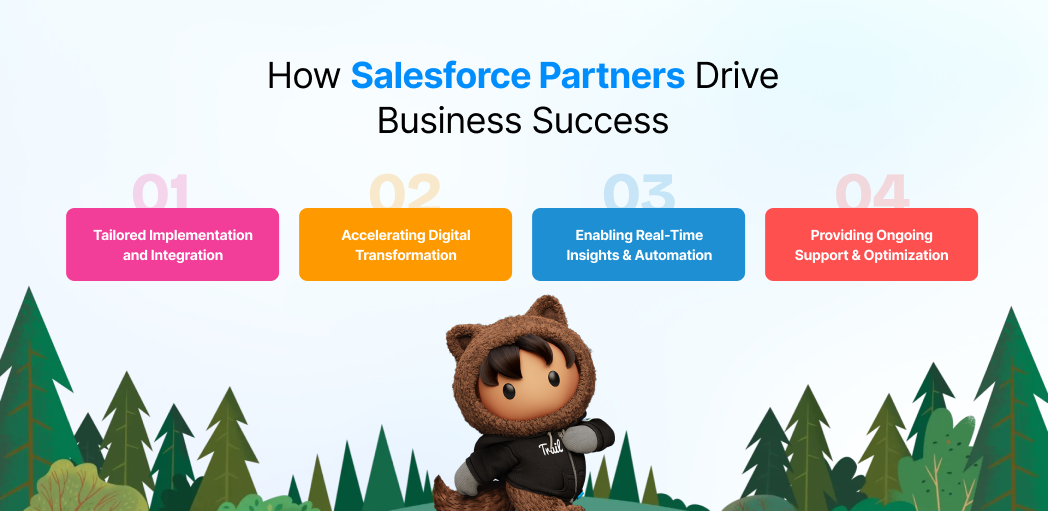
In today’s fast-paced digital world, businesses need solutions that are not only robust but also tailored for their unique challenges. Salesforce Partners play a pivotal role in helping organizations unlock the full potential of the Salesforce platform, driving significant business success across industries. This blog explores the ways Salesforce Implementation Partners empower companies to innovate, streamline operations, and boost growth.
Tailored Implementation and Integration
Salesforce Implementation Partners customize Salesforce solutions to fit individual business needs, integrating CRM with marketing automation, finance, support, and other enterprise systems. This creates a seamless data flow that enhances decision-making and customer experiences. For example, partners have enabled organizations to synchronize Salesforce with ERP and marketing platforms, improving operational efficiency across departments.
Accelerating Digital Transformation
By leveraging Salesforce Partners, businesses accelerate their digital journeys. Partners mitigate risks by ensuring projects are delivered on time, within scope, and aligned with strategic goals. They bring best practices, certified skills, and industry-specific knowledge, reducing costly trial-and-error implementations.
Enabling Real-Time Insights and Automation
Salesforce Partners implement automation workflows and dashboards that empower sales, marketing, and service teams to act on real-time data. This leads to faster sales cycles, improved customer satisfaction, and increased ROI. For instance, financial services firms saw a 361% marketing campaign ROI within months of partner-led Salesforce Pardot implementation.
Providing Ongoing Support and Optimization
Business needs evolve, and Salesforce Partners continue to provide managed services ensuring systems are optimized, user adoption is high, and emerging Salesforce innovations are incorporated. This long-term relationship safeguards investments and keeps businesses competitive.
Why Work With a Salesforce Partner?
A Salesforce partner is a certified Salesforce consulting company that helps businesses implement, customize, and optimize Salesforce solutions. From CRM setup to app development, data migration, or third-party integrations, Salesforce partners bring the expertise you need to maximize ROI.
But choosing the right partner isn’t just about affordability; it’s about finding a balance between experience, capability, and long-term value.
The Value of a Salesforce Partner
- Expertise and Certification: Salesforce partners undergo rigorous certification processes, which means they bring proven knowledge and best practices to every project.
- Customization and Scalability: No two businesses are alike. A trusted partner ensures Salesforce adapts to your business model, not the other way around.
- Maximized ROI: With proper integration, automation, and optimization, companies see faster time-to-value and long-term efficiency gains.
- Ongoing Support: Salesforce is constantly evolving. A partner keeps your system up to date, scalable, and aligned with your growth.
How Much Does a Salesforce Partner Cost? Key Factors to Consider Before Choosing One
When businesses start their Salesforce journey, one of the most common questions is: “How much does a Salesforce partner cost?” While it’s tempting to look for a fixed price, the reality is that the cost of working with a Salesforce partner varies widely.
That’s because every business has unique goals, processes, and challenges, and so does every Salesforce partner. Instead of focusing on the dollar amount, it’s better to understand the criteria that influence the cost and the value you get in return.
In this blog, we’ll explore the key factors that impact Salesforce partner costs, so you can make an informed decision that aligns with your business needs.
Key Criteria That Impact the Cost of a Salesforce Partner
1. Scope of Services: The more complex your Salesforce needs, the higher the investment required.
Simple setup vs. advanced customization.
- One-time implementation vs. ongoing support.
- Basic integrations vs. multi-app ecosystems.
2. Level of Expertise: Salesforce partners come in different tiers Registered, Silver, Gold, and Platinum. Higher-tier partners typically bring deeper expertise and proven track records, which can influence cost.
3. Industry Specialization: Partners who specialize in specific industries (like healthcare, finance, or eCommerce) often charge differently because of their domain expertise. While this may increase the investment, it ensures your Salesforce solution is tailored to industry standards.
4. Customization & Development Needs: Do you just need an out-of-the-box Salesforce setup, or do you require custom development, dashboards, automation, and integrations? The complexity of your project directly impacts partner engagement.
5. Team Size and Resources: Some partners provide a small, dedicated team, while larger firms may assign multiple consultants, developers, and architects. The resource model influences how costs are structured.
6. Project Duration: Short-term projects typically involve one-time engagements, while long-term Salesforce transformations require sustained investment in managed services and ongoing support.
7. Geographic Location: Partners based in North America or Europe may have different cost structures compared to those in Asia or other regions. However, location doesn’t always dictate quality; it’s about finding the right fit.
8. Support & Post-Implementation Services: Many businesses overlook ongoing support costs. A good Salesforce partner provides continuous monitoring, upgrades, and troubleshooting. The level of post-implementation care is a key factor in long-term cost.
Value Over Price: Why the Cheapest Partner May Not Be the Best
It’s natural to want to save money, but when it comes to Salesforce, going for the lowest-cost option can be risky. Inadequate implementation or poor customization often leads to:
- Data inconsistencies
- Inefficient processes
- Higher costs in rework later
The real question isn’t “How much does a Salesforce partner cost?” but rather, “What value does this partner bring to my Salesforce investment?”
How to Choose the Right Salesforce Partner: A Practical Guide
Choosing the right Salesforce Partner is a crucial decision that can make or break your Salesforce implementation success. With Salesforce’s powerful platform offering endless possibilities, picking the right partner ensures your business goals are met efficiently, within budget, and with minimal disruption.
Here’s how to find the best Salesforce Partner suited to your needs:
1. Define Your Business Goals and Requirements
Before starting your search, outline what you want to achieve with Salesforce. Are you implementing for the first time, optimizing existing workflows, or integrating third-party apps? Clear goals help you target partners with relevant expertise.
2. Look for Proven Expertise and Certifications
Certified partners demonstrate technical mastery. Verify that your potential partner holds Salesforce certifications, whether as administrators, developers, or consultants. Those with extensive certifications and ongoing training stay current with platform updates.
3. Evaluate Industry Experience
A partner experienced in your industry understands niche challenges and compliance requirements. They can offer tailored solutions and pre-built configurations, accelerating deployment and minimizing risks.
4. Check Track Record and Client Success Stories
Review case studies and references. Partners with proven success in handling projects of similar size and complexity bring reliability and confidence to your project.
5. Assess Cultural Fit and Communication
Effective collaboration is key. Choose a partner whose communication style, responsiveness, and values align with your organization. This ensures smoother project execution and shared commitment to success.
6. Ensure Scalability and Future Support
Your business will grow, and so should your Salesforce solution. Pick a partner who offers scalable services and ongoing support, including training and troubleshooting, to keep your system optimized.
7. Understand Their Delivery and Project Management Approach
Ask about their methodology, how they manage milestones, risks, and resources. Transparent processes with regular updates reduce surprises and keep your project on schedule.
8. Consider Location and Availability:
Determine whether you need on-site or remote resources. The right partner balances local presence and technical expertise to fit your project needs and budget.
Real-World Use Cases & Success Stories
Many thriving organizations credit their transformation to a strategic Salesforce Partner.
Example 1: A retail brand facing fragmented customer data worked with a Crest-tier Consulting Partner. The partner architected a solution integrating Salesforce CRM, marketing automation, and supply chain management. The result: unified customer profiles, predictive insights, and a 60% boost in campaign ROI.
Example 2: An international B2B firm needed to streamline contract management and post-sales support. Their partner configured Service Cloud, integrated with ERP systems, and automated support processes, cutting response times in half and raising CSAT scores by 25%.
Example 3: A SaaS provider engaged an ISV to build a custom app on the AppExchange that solved data migration pain points. Customers benefited from fast, secure onboarding, unlocking new selling opportunities for both the ISV and their clients.
Conclusion: Turning Salesforce Into a Growth Engine
Salesforce has established itself as the gold standard in CRM, but the true value lies in how effectively it’s implemented, customized, and optimized for your unique business needs. A certified Salesforce Partner bridges the gap between technology and business outcomes, bringing not just technical skills, but also industry knowledge, proven methodologies, and ongoing support. By choosing the right partner, organizations can accelerate digital transformation, boost customer engagement, and unlock higher ROI.
While cost is an important consideration, value outweighs price every time. The right partner becomes a long-term ally in your success, ensuring that Salesforce continually grows with your business and keeps you competitive in a fast-changing market.
Why Choose HIC as Your Salesforce Partner
At HIC, we combine deep Salesforce expertise with real-world industry experience to design solutions that are practical, scalable, and future-ready. Whether you’re implementing Salesforce for the first time, integrating complex systems, or optimizing for maximum ROI, HIC is equipped to guide you at every step. HIC’s certified consultants, proven client success stories, and hands-on approach make us more than just a vendor we’re your strategic growth partner.
Let HIC help you transform Salesforce into a powerful driver of customer excellence and business growth.
Ready to take your Salesforce journey to the next level? Partner with HIC today and start building smarter solutions for tomorrow.

Frequently Asked Questions
Who is a Salesforce Partner?
A Salesforce Partner is a certified organization approved by Salesforce to deliver consulting, implementation, integration, and software services on the Salesforce platform. These partners undergo rigorous vetting and maintain deep product expertise, helping clients maximize ROI from Salesforce’s suite of cloud applications.
What types of Salesforce Partners exist?
Salesforce Partners come in several forms, including Consulting Partners (strategic guides for implementations), AppExchange & ISV Partners (build and market apps/extensions), Managed Service Providers (ongoing system management), Reseller Partners (specialized product sales), and System Integrators (integration across platforms).
How are Salesforce Partners classified?
Salesforce Partners are ranked by experience, certifications, and customer impact in tiered programs: legacy tiers include Registered, Silver, Gold, and Platinum/Global Strategic; the modern system features Base, Ridge, Crest, and Summit. Higher tiers indicate greater expertise, resources, and proven success in complex projects.
How do Salesforce Partners drive business success?
Salesforce Partners help organizations innovate, streamline operations, and boost growth through tailored implementations, integration of enterprise systems, automation, and ongoing optimization and support. Their involvement leads to faster projects, higher ROI, and long-term business competitiveness.
What factors influence the cost of working with a Salesforce Partner?
Key criteria impacting cost include scope of services, level of expertise/tier, industry specialization, customization and development needs, team size, project duration, geographic location, and support services. Higher value, not lower price, should guide partner choice.
How should a business choose the right Salesforce Partner?
Define clear business goals, seek partners with relevant certifications, evaluate industry experience, review client success stories, ensure cultural fit and communication, prioritize scalability and support, understand project management methods, and consider location needs. Reliable partners align with both technical and strategic business objectives.
What are some real-world benefits of partnering with Salesforce experts?
Examples include retail brands achieving unified customer insights and boosted ROI, B2B firms improving contract management and customer support, and SaaS providers leveraging ISV partners for custom app solutions and expedited onboarding—demonstrating tangible improvements in efficiency and customer engagement.
How much do Salesforce partners make?
The average salary of a Partner Account Manager at Salesforce in India ranges between ₹24.7 Lakhs and ₹40.0 Lakhs annually, depending on experience, which typically spans from 2 to 10 years. The top 10% of Partner Account Managers earn over ₹40.0 Lakhs per year, with the top 1% also crossing the ₹40.0 Lakhs mark.