

As a marketer, it’s essential to comply with the CAN-SPAM Act to protect yourself from potential litigation and to demonstrate your commitment to providing relevant customer messaging.
As spam emails can result in a negative impact on your brand reputation, lower email deliverability rates, and potential legal implications, Salesforce Marketing Cloud, a trusted platform for email marketing, processes unsubscribe requests to help you remain compliant with the CAN-SPAM Act.
In this edition today, we will explore how Salesforce Marketing Cloud complies with the CAN-SPAM requirement and what happens in Marketing Cloud before your email reaches your subscriber’s inbox. So, let’s begin!
What is CAN-SPAM Compliance Act?
CAN-SPAM Act stands for Controlling the Assault of Non-Solicited Pornography and Marketing Act. As a federal law, it lays out the rules and requirements for commercial email, as well as the right to opt out of receiving commercial email.
Leveraging Marketing Cloud’s standard practices, you can stay compliant with the CAN-SPAM Act and avoid spamming.
Here are six best practices for CAN-SPAM compliance in Salesforce Marketing:
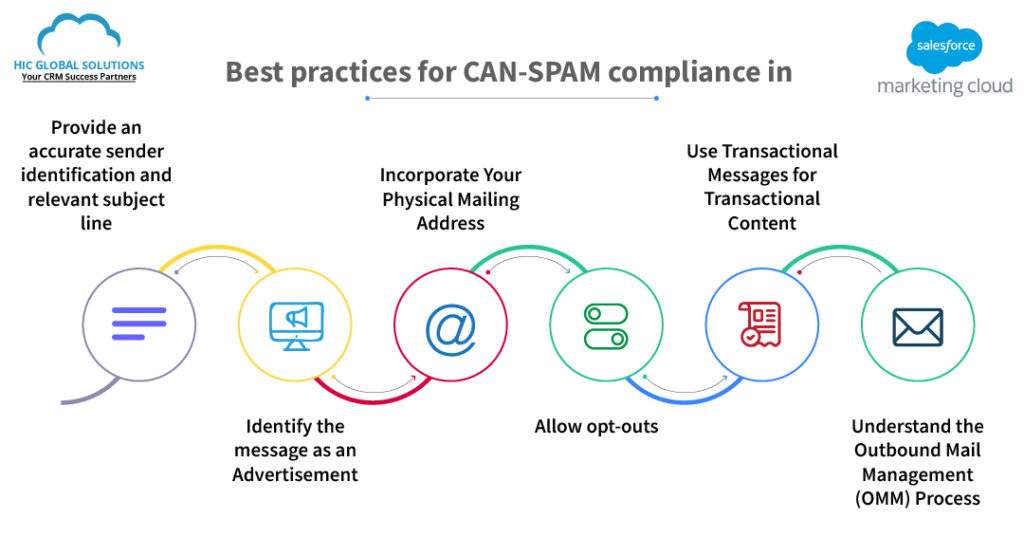
1. Provide an accurate sender identification and relevant subject line
Your commercial emails should accurately identify the sender in the header information containing a subject line that clearly indicates the email’s content. This will help establish trust with your subscribers and avoid misleading them.
2. Identify the message as an Advertisement
If your mailing has the primary purpose of delivering commercial content, you should identify it as an advertisement unless the subscriber gives his/her explicit consent (opt-in). Clearly labeling your email as an advertisement helps subscribers understand what they are receiving and allows them to make an informed decision about whether to open and engage with your message.
3. Incorporate Your Physical Mailing Address
Make it a practice to add your physical mailing address in every commercial email you send. This not only helps establish trust with your subscribers but is also a requirement under the CAN-SPAM Act.
4. Allow opt-outs
To comply with email regulations, it is imperative to provide subscribers with a simple method to opt out of receiving further emails. It is prohibited to require subscribers to log in or take multiple steps to unsubscribe. Plus, you must process opt-out requests immediately, within a ten-day time frame. Furthermore, the unsubscribe mechanism must be available for a minimum of thirty days following email distribution.
5. Use Transactional Messages for Transactional Content
Transactional messages, whose primary purpose is to communicate transactional content, are mostly exempt from CAN-SPAM requirements except for accurate sender identification. Use transactional messages for all transactional content to avoid confusing your subscribers and ensure that your commercial messages comply with CAN-SPAM.
6. Understand the Outbound Mail Management (OMM) Process
When you send an email in Marketing Cloud, a series of processes takes place behind the scenes before your email reaches your subscriber’s inbox. Understanding the OMM process can help you understand why your send executes immediately or takes longer than normal. OMM analyzes the email, builds the email structure, analyzes the subscribers, and finally builds and sends the email in batches. Knowing this process can help you optimize your send times and improve email deliverability.
Wrap Up
Hence, by complying with these best rules, you can practice safe email marketing with Salesforce Marketing Cloud. Not only will this help you maintain a positive brand reputation, but it will also increase the effectiveness of your email campaigns.
If you have questions about Marketing Cloud or need assistance implementing Marketing Cloud features in your business, contact HIC Global Solutions. Contact us today!